


A Guide to Different Jewelry Styles
Most people sort their jewelry by price or by material. Sorting by style gives you more usable information, because style tells you where a piece belongs in your day and what it will pair with.
Seven categories cover nearly everything on the market, from designs that have held their shape for over a century to newer ones built around materials that had no place in fine jewelry a generation ago.
In this guide, we will walk through the main jewelry styles, what defines each one, and who reaches for it.aa
Key Takeaways
-
Classic jewelry earns its name through proportion and restraint, and the visual markers are easy to spot once you know them.
-
Minimalist design removes ornament, which puts all the pressure on finish quality.
-
Vintage style borrows from specific decades, and each decade left its own signature.
-
Modern jewelry broke from tradition by changing materials before it changed shapes.
-
Silicone rings turned a performance material into a style category of its own.
-
Statement pieces work on one rule that most wearers get backwards.
-
Personalized designs are defined by meaning, so they can overlay any other style.
Classic Jewelry
Classic jewelry holds its position through balanced proportion and limited ornament, which keeps any given piece from being tied to a single decade. Nothing about the design announces the year it was made.

The markers are consistent enough to recognize at a glance. Symmetry runs through the whole piece, and a single stone carries the focus in a bezel or simple prong setting that supports the gem without decorating it. Yellow and white gold dominate, and curves outnumber angles.
Two shapes have never left circulation: the signet ring and the solitaire. Both have stayed in production for generations, and both still read as current.
Classic and timeless jewelry get used interchangeably, though they describe different qualities. Classic refers to a recognized design language with established rules, and timeless describes any piece that stays relevant regardless of trend cycles.
Minimalist Jewelry
Minimalist pieces strip away ornament so that line, finish, and proportion carry the design alone. Fewer decisions go into the piece, and every surviving decision becomes visible.
That visibility raises the bar for craftsmanship. An uneven bezel or an inconsistent polish disappears inside an ornate setting, but a plain band has nothing to absorb the error. Buyers of minimalist jewelry pay close attention to details that other styles let you overlook.
Four things worth inspecting before you buy:
-
Bezel seating – the metal should sit flush against the stone with no visible gap.
-
Band consistency – width should hold steady from front to back with no tapering.
-
Finish uniformity – polished and brushed surfaces should each stay even across the whole piece.
-
Stone centering – off-center placement shows immediately on a symmetrical design.
Restraint suits everyday jewelry well, since a piece with no protruding decoration has nothing to catch on sleeves or gloves.
Vintage Style Jewelry
Vintage style jewelry reproduces the design language of a specific past decade. Each period left signatures distinctive enough to identify without any expertise.
|
Era |
Visual Signature |
Where You Still See It |
|
Victorian |
Romantic motifs, garnets and pearls, detailed metalwork |
Cluster rings, lockets, ornate bands |
|
Art Deco |
Strict geometry, sharp symmetry, contrasting stone colors |
Emerald cuts, stepped shoulders, baguette accents |
|
Mid-Century |
Clean lines, new materials, relaxed proportions |
Cocktail rings, textured gold, spiral forms |
Vintage and antique carry different meanings in the trade, with antique applying to pieces made at least a hundred years ago and vintage covering roughly twenty to a hundred years. Reproductions sit outside both terms, since they borrow the look without the age.
Reproduction has one practical advantage here. Original settings from the 1920s were built for occasional wear and careful storage, so daily use puts real strain on them, and newer versions of the same designs are constructed for the way people wear these kinds of jewelry now.
Modern Jewelry
Modern jewelry breaks the rules that classical design followed. Symmetry becomes optional, settings sit off-center on purpose, and a piece no longer has to balance itself around one central stone.
Designers stopped treating precious metal as the only acceptable base. Ceramic entered fine jewelry as a serious material and now appears alongside sterling silver in pieces built to take daily wear. Mixed construction became normal, with two or three materials meeting in a single ring, and negative space started doing structural work in a design.
Growing interest in aesthetic jewelry pushed designers to consider how a piece photographs and how it coordinates with a wardrobe, questions traditional fine jewelry never had to answer.
Silicone Ring With Diamond
View Full Collection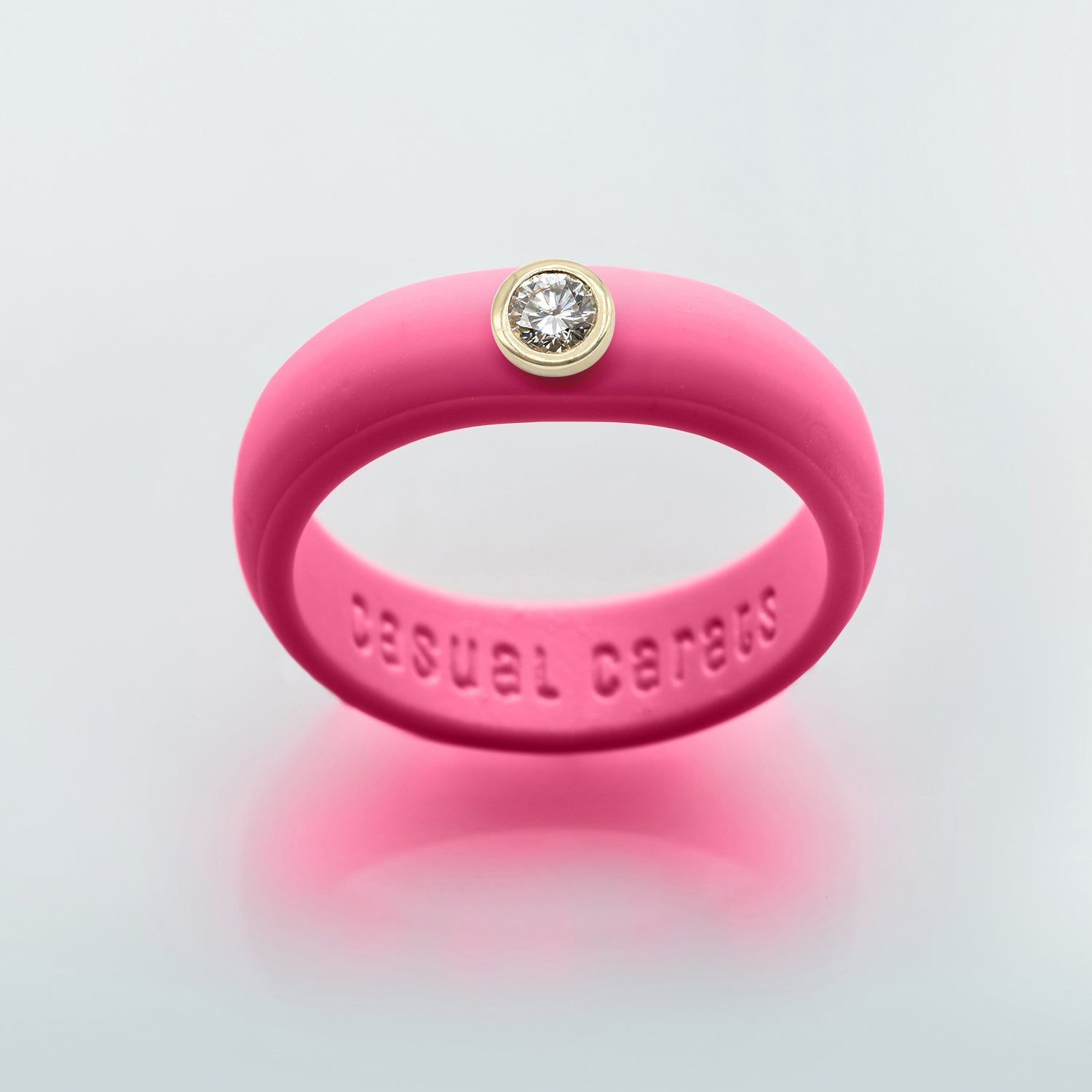
Silicone Rings
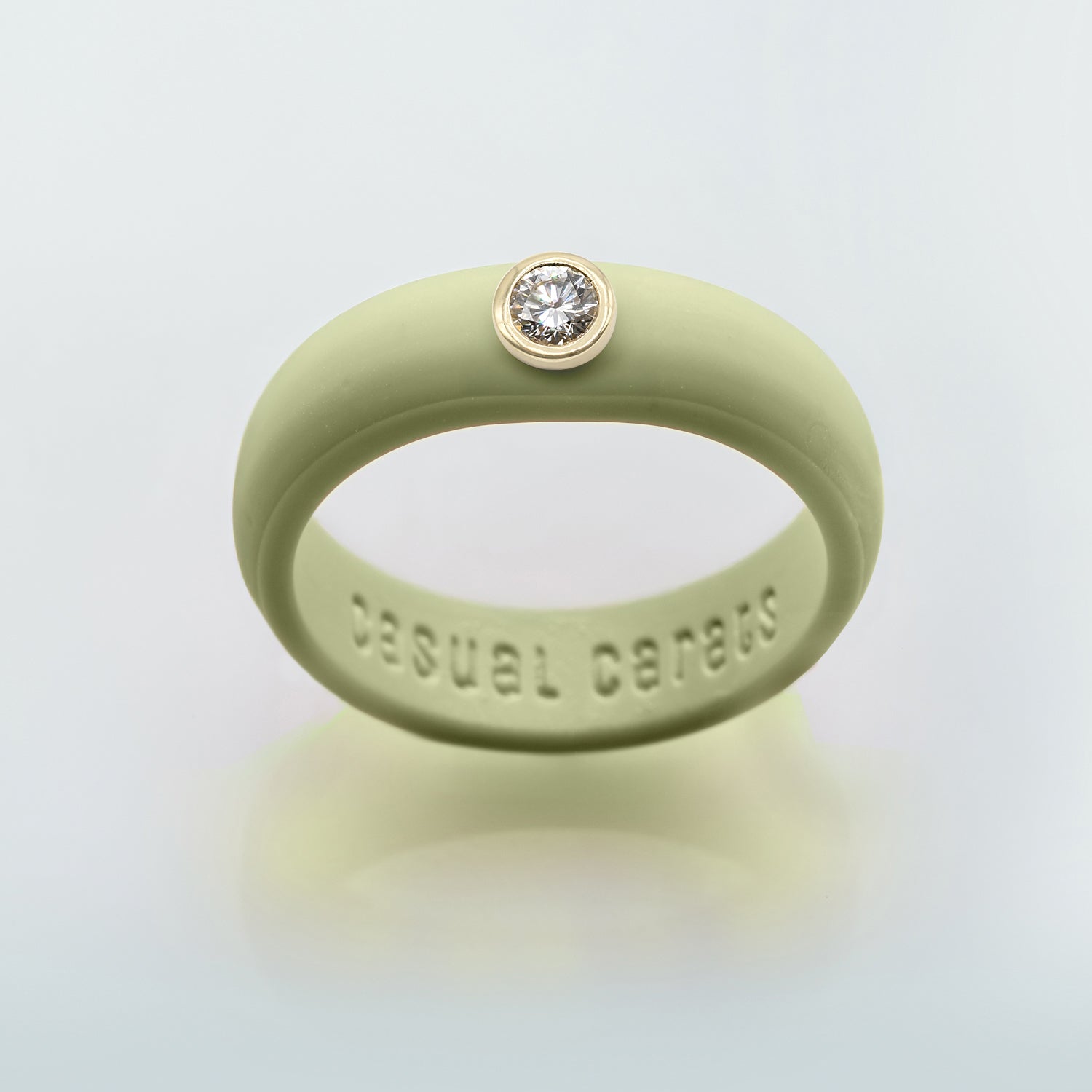
Silicone rings occupy a category that older jewelry styles do not account for, because the material defines the look before any stone is added. Everything else on this list starts with metal and decides what to put on it.

A Band That Moves With Your Hand
Flexibility changes the visual result, not only the comfort. A silicone band lies flat against the finger with no rigid edge, so the gold bezel and the stone become the only raised parts of the ring. The band itself recedes visually.
Genuine Stones on a Flexible Band
Don’t think of silicone as something cheap, the stones in it are real. We at Casual Carats set genuine diamonds, birthstones, and colored gemstones in solid 14K gold bezels fitted into high-grade silicone bands. The gold and the gemstone meet the standards used in traditional fine jewelry, and the band handles the parts of the day that a rigid metal ring cannot.
Color as a Design Choice
Band color works as a design variable that no other style offers. One setting reads completely differently depending on what is beneath it. Neutral bands in nude, stone gray, or champagne let the diamond hold attention, and saturated bands in cherry, kelly green, or midnight blue turn the ring into the loudest piece on the hand.
This makes silicone the practical and beautiful choice for everyday jewelry, since the ring stays on through workouts, dishes, and manual work without coming to any harm.
Statement and Fashion Jewelry
Statement jewelry earns attention by being the largest or the brightest object in view, so everything around it has to give way. Of all the jewelry styles here, this one is the least forgiving of company: a cognac emerald cut on the index finger holds the eye only as long as the neighboring fingers stay bare.
Size is the most direct route to that effect, and the least subtle. An unexpected stone color does the same job at a fraction of the volume, which is why a 0.50ct cognac pear or a fancy vivid blue marquise pulls the eye through hue, not bulk. Sculptural form and asymmetry manage it on pieces small enough for a workday.
Fashion jewelry describes something separate that gets confused with the above. The term covers pieces made for a trend cycle, usually with plated metals and simulated stones, priced for replacement within a season or two. Bold designs built from genuine materials belong to a different category, since they outlast the trend that inspired them.
Personalized Jewelry
Personalized jewelry gets its definition from meaning, not from appearance, which is why it can look classic, minimal, or modern depending on how it is made.
Three routes cover most of what is available:
-
Initials – pure typography, where the letterform carries the entire design
-
Birthstones – meaning delivered through color, with each month assigned its own gem
-
Symbols and zodiac marks – legible to people who recognize them and readable as geometry to everyone else
Personalization layers over other jewelry styles without replacing them, which makes it the easiest category to add to a collection you have already built. A diamond initial in a 14K gold bezel follows the same proportional rules as classic jewelry and carries a name at the same time.
Choosing Where to Start
These jewelry styles are descriptive labels, not exclusive ones. Most collections span three or four, and a single piece can fall into two at once.
The useful starting question concerns your hands more than your taste. What do they do between waking up and going to bed? A ring you remove six times a day never becomes part of how you dress, no matter how much you liked it in the case. Match the style to the schedule first, then choose within it.
Anyone whose day involves lifting, washing, or patient care will find that modern jewelry built on flexible materials answers a question the older categories were never designed to address.
FAQ


