


Moissanite vs Diamond Comparison Guide
Two gems can look almost identical under a jewelry store light and behave very differently once you wear one every day. That is the honest starting point for anyone deciding between a moissanite and a diamond.
Both sparkle, both hold up well, and both come in shapes and sizes that suit rings and gemstone jewelry. What sets them apart comes down to what each stone is made of and how it handles light.
In this guide, we will cover what each one is, how the two compare side by side, how moissanite measures up against a lab-grown diamond, and how to land on the right pick for your budget and your daily life.
Key Takeaways
-
Moissanite is silicon carbide, and a diamond is pure carbon. That one difference drives most of what follows.
-
Moissanite gives off more colorful flashes, and a diamond returns more white light.
-
On hardness, a diamond scores 10 and moissanite scores 9.25, so both stand up to daily wear.
-
A lab-grown diamond is chemically a diamond, and moissanite is a separate mineral, which changes how the two line up.
-
The price gap between them is real, and the two stones are not even priced the same way.
-
Your final pick rests on budget, the kind of sparkle you like, and what the stone means to you.
What Is Moissanite?

Moissanite is a lab-created gem made of silicon carbide.
A French chemist named Henri Moissan first found it in 1893 inside a meteorite crater in Arizona. Natural moissanite is so rare that almost none of it reaches jewelry counters, so the moissanite you can buy is grown in a lab from silicon carbide crystals.
Its look comes from two optical traits.
Moissanite has a refractive index of 2.65–2.69, which sends a lot of light back to your eye. It also has a dispersion value of 0.104, a measure of how the stone breaks white light into color.
Those numbers give moissanite its bright, colorful flash, the kind that shows up strongly in sunlight. One more quirk sets it apart in the case. Moissanite is doubly refractive, so each ray of light entering the stone splits into two before it reflects back.
What Is a Diamond?

A diamond is pure carbon, crystallized under heat and pressure into the hardest gem material known. It scores a 10 on the Mohs scale, the top of the chart, which makes it highly resistant to scratches. Diamonds form in nature over a very long span of time, and they are also grown in labs that recreate the same carbon structure. Both kinds are real diamonds with the same makeup.
What people notice first is the sparkle. A diamond has a refractive index of 2.42 and a dispersion value of 0.044, which together produce a clean, bright white flash with softer touches of color.
That balance is the look most people expect from fine jewelry. Diamonds also carry a long history tied to engagement rings, milestones, and pieces handed down in families.
If you want a closer look at grades, shapes, and pricing before you buy, our diamond buying guide walks you through the details.
How Do Moissanite and Diamond Compare Side by Side?

Set a moissanite next to a diamond, and the differences run from what each stone is made of all the way to what you pay. The table below lines up the traits that matter most when you shop.
|
Trait |
Diamond |
Moissanite |
|
What it is made of |
Pure carbon |
Silicon carbide |
|
Mohs hardness |
10 |
9.25 |
|
Toughness |
Very tough, though cleavage planes can chip if struck on an edge |
No distinct cleavage, strong resistance to chipping |
|
Refractive index |
2.42 |
2.65–2.69 |
|
Dispersion (fire) |
0.044 |
0.104 |
|
Color |
Colorless through fancy shades |
Near colorless, can show a warm or greenish tint in larger sizes |
|
Weight for the same size |
Heavier, specific gravity 3.52 |
Lighter, specific gravity about 3.21 |
|
Heat resistance |
High |
Very high, holds up past 2,000°F |
|
How to tell them apart |
Single refraction, no doubled facets |
Double refraction, doubled facet edges show under a loupe |
|
Grading report |
4Cs report from labs like GIA or IGI |
GRA certificate or maker warranty, not graded on the diamond 4Cs |
|
Priced by |
Carat weight |
Size in millimeters |
|
Relative price |
Higher |
Lower |
|
Resale market |
Well established |
Limited |
The clearest split is the sparkle. Moissanite gives off more colorful flashes because of its higher dispersion. Some people love that extra fire, and some find it too showy. A diamond holds a whiter, calmer shine that reads as classic. Price is the other clear difference. A diamond is priced by carat weight, and moissanite is priced by its size in millimeters, since it weighs less than a diamond of the same measurements. For most shoppers, that price gap ends up being the deciding point.
Is a Lab-Grown Diamond the Same as Moissanite?
No, and the reason matters when you compare prices. A lab-grown diamond is pure carbon with the same makeup as a mined diamond, so it tests as a real diamond and carries the same hardness and white sparkle. Moissanite is silicon carbide, a separate mineral with its own look.
You may also see a lab-grown diamond called a synthetic diamond, which points to the same stone, a diamond made in a lab.
|
Trait |
Moissanite |
Lab Grown Diamond |
|
What it is made of |
Silicon carbide |
Pure carbon, same as a mined diamond |
|
Mohs hardness |
9.25 |
10 |
|
Toughness |
No distinct cleavage, strong resistance to chipping |
Very tough, though cleavage planes can chip if struck on an edge |
|
Refractive index |
2.65–2.69 |
2.42 |
|
Dispersion (fire) |
0.104 |
0.044 |
|
Sparkle |
Bright, colorful fire |
White brilliance of a natural diamond |
|
Color |
Near colorless, can show a warm or greenish tint in larger sizes |
Graded on the D to Z scale, available fully colorless |
|
How it is made |
Grown in a lab, around 2 to 3 months |
Grown in a lab, around 3 to 4 weeks |
|
Tests as a diamond |
No |
Yes |
|
Grading report |
GRA certificate or maker warranty |
Full 4Cs report from IGI or GIA |
|
Resale value |
Little established resale market |
Holds more resale value than moissanite |
|
Relative price |
Lowest |
Higher than moissanite, lower than mined |
A lab diamond and moissanite share a lab origin and a friendlier price than a mined stone, and that is where the overlap ends. Lab-grown diamonds cost more than moissanite, and they give you the exact hardness and sparkle of a natural diamond. Moissanite saves you more money and brings its own brighter flash.
If a genuine diamond appeals to you at a gentler price, our lab-grown diamond rings offer that in a range of styles.
Explore Our Lab-Grown Diamond Collection
Browse All Collections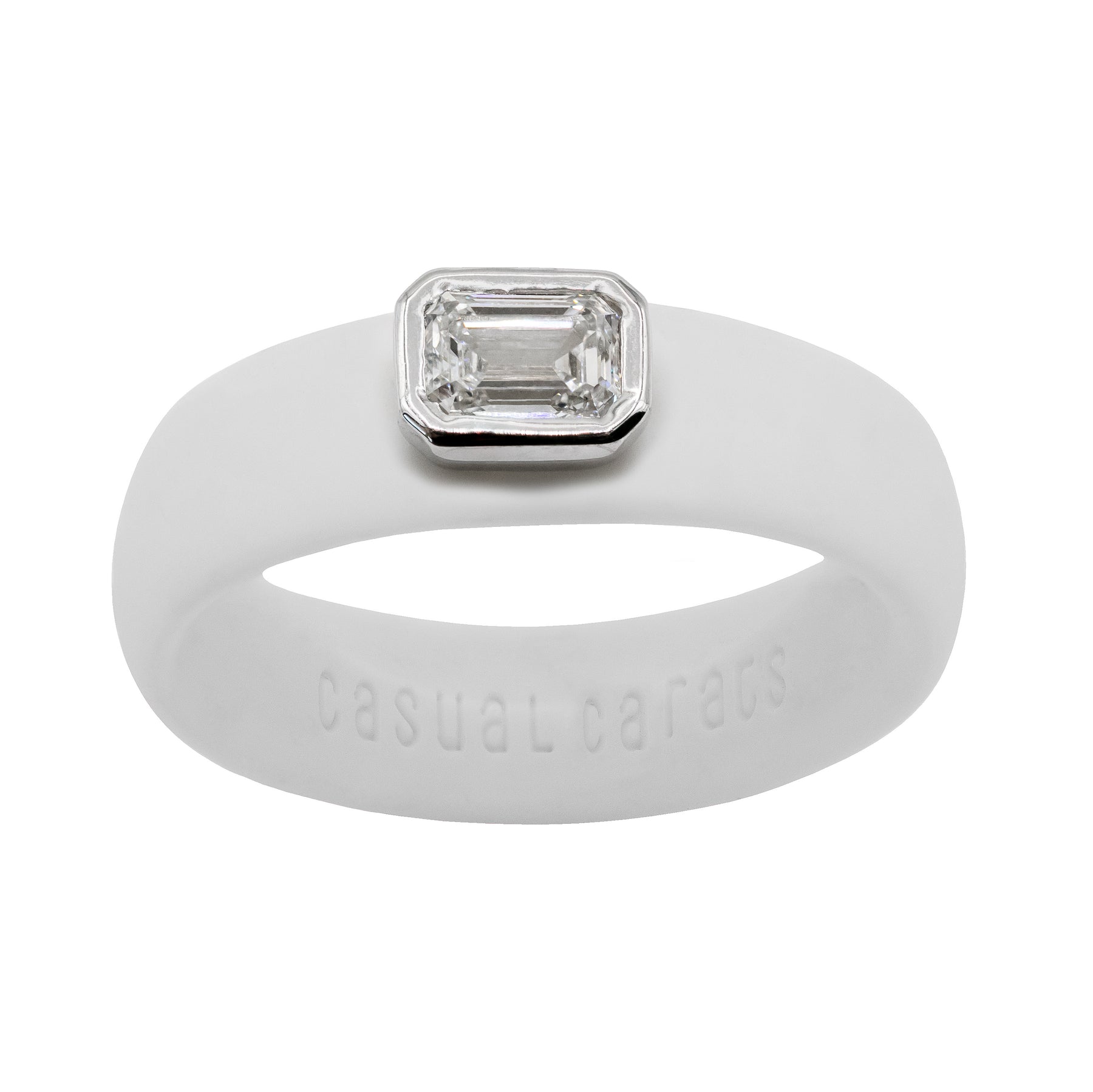
Which Stone Holds Up Better for Everyday Wear?
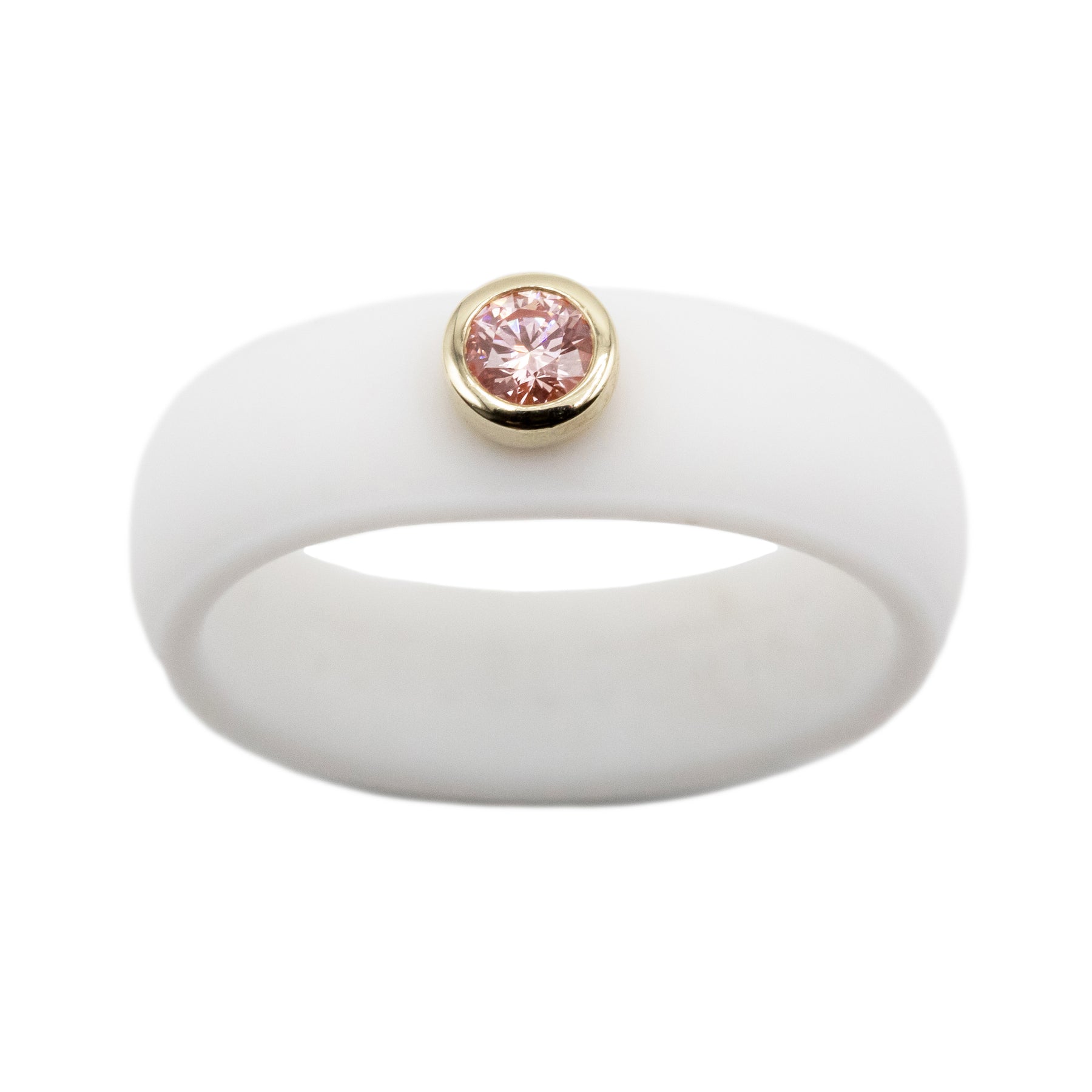
Both stones handle daily life well, and the setting matters as much as the stone. A moissanite and a diamond each resist damage better when the setting guards their edges, and a bezel setting does exactly that. A bezel wraps a thin rim of metal around the stone, so the points most open to knocks stay covered through hands-on days.
For an active routine, a few things make wear easier.
-
A lower profile stone catches on fewer surfaces during workouts, cleaning, and yard work.
-
A bezel setting shields the girdle of the stone, the spot most likely to chip.
-
A flexible band keeps the ring comfortable through a full day of movement.
We built our collections around this idea, real diamonds you can keep on while you move. Our silicone rings with diamonds hold a genuine diamond in a 14K gold bezel on a flexible silicone band, so you keep the sparkle of a real stone in a ring that sits low, stays secure, and moves with you. Each one comes in a wide range of colors and sizes to match your hand and your day.
How Do You Choose Between Moissanite and Diamond?

Choosing between a moissanite and a diamond comes down to a few clear priorities. Line them up against what you want, and the right stone tends to stand out.
-
Budget first. Moissanite gives you the most sparkle for the lowest spend. A lab-grown diamond sits in the middle, and a mined diamond sits at the top.
-
Sparkle style. Reach for moissanite if you like bold, colorful flash. Reach for a diamond if you prefer a whiter, quieter shine.
-
Meaning and resale. A diamond holds long-standing symbolism and a real resale market. Moissanite carries neither in the same way, and for many buyers that trade is worth the savings.
-
How you wear it. For rough, hands-on days, either stone works when it sits in a protective setting on a comfortable band.
FAQ


