


College Rings Guide to Traditions, Meaning, and Modern Styles
A college ring represents something earned. These rings require meeting academic benchmarks, completing credit hours, and qualifying through an official university program. That earned status is what sets them apart.
In this guide, we will cover what separates university rings from high school class rings, the college ring traditions behind them, why the Texas A&M Aggie Ring is the most recognized one in the country, and how modern materials have changed what school pride looks like on your hand.
Key Takeaways
-
Collegiate rings and class rings share roots but serve different purposes at the university level.
-
The tradition started as a military custom in 1835 and became formalized university programs by mid-century.
-
Texas A&M runs the largest college ring program in the country, with traditions dating to 1889.
-
Aggie Ring Day and the ring dunk are two of the most distinctive celebrations in college culture.
-
Modern materials let graduates wear school pride daily without the drawbacks of traditional metal rings.
How Did College Rings Go from Military Custom to Campus Tradition
The first class rings appeared at West Point in 1835, where cadets designed matching bands to mark a shared accomplishment. That military origin set the template: a uniform ring representing collective identity.

Civilian universities adopted the practice in the early 1900s. Harvard, Yale, and Princeton were among the first, treating college rings as markers of institutional prestige.
By mid-century, the practice had reached public universities across the country. The defining change came when schools stopped letting each graduating class design its own ring and began establishing official programs with fixed designs and eligibility requirements. That move turned the college ring from a student-organized keepsake into a university-controlled credential.
Texas A&M formalized its ring in 1889, decades before most schools. The Citadel, Virginia Military Institute, and the Naval Academy each built programs along similar lines: the ring had to be earned, and its design had to be instantly recognizable.
How Do Collegiate Rings Differ from High School Class Rings
The biggest difference is who controls the design and who qualifies to wear it.
High school class rings center on personal customization. Students pick their birthstone, sport, engraving, and metal. College rings work the opposite way. At universities with official ring programs, the design is standardized. You earn the right to wear it by meeting academic requirements, and the ring reflects the institution and your place in its alumni network.
A collegiate ring functions as a credential. Some universities prohibit personal design changes entirely, keeping the ring recognizable across decades.
Our guide on what a class ring is covers the broader origin story, turning traditions, and wearing etiquette behind these rings.
|
High School Class Ring |
College/Collegiate Ring |
|
|
Design Control |
Student chooses stone, engraving, symbols |
University controls standardized design |
|
Eligibility |
Open to juniors and seniors |
Requires completed credit hours, minimum GPA |
|
Customization |
Birthstone, sport, activities, personal engravings |
Minimal or none; uniformity is intentional |
|
Primary Purpose |
Personal keepsake |
Institutional credential and alumni identification |
What Traditions Give College Rings Their Meaning
College ring traditions are campus-specific cultures, not a single nationwide custom.

Clemson's Ring Week includes ROTC cadets standing overnight guard over the rings before distribution. The Citadel's ceremony is rooted in military protocol. Alabama hosts a formal ring presentation for students who meet their academic benchmarks. At schools with strong ring programs, the ring becomes a recognition tool after graduation. Alumni identify each other's rings across cities and industries, creating an immediate connection with fellow graduates they've never met.
College team rings serve a different purpose. They represent school sports pride and fan loyalty, giving graduates and fans a way to show their school affiliation in everyday life without the formality or cost of a traditional gold ring.
What these traditions share: the ring earns its meaning from what it takes to get one.
Why Is the Texas A&M Aggie Ring the Most Famous College Ring in America
The Texas A&M ring program is the largest in the country, with over 15,000 rings ordered each year and a 94% purchase rate among eligible undergraduates.
The first Aggie Ring was cast in 1889 with intertwined letters "AMC" (Agricultural and Mechanical College) and four diamonds. E.C. Jonas, Class of 1894, designed the version that established the template still in use.
In 1933, university president Thomas Walton standardized the design, ending years of class-by-class variations. The ring has looked virtually identical since, with the only change coming in 1963 when the school was officially renamed Texas A&M University.
The Aggie Ring meaning is built into its symbols:
-
Eagle on the crest represents agility and the ability to reach great heights
-
Shield symbolizes the duty to protect the alma mater's reputation
-
Five stars stand for mind, body, spiritual attainment, emotional poise, and integrity of character
-
13 stripes represent patriotism, referring to the original states
-
Cannon, saber, and rifle honor the school's military heritage
-
Texas state seal appears on one side of the ring
That deliberate symbolism is one reason the Aggie Ring is recognized far beyond campus and across college rings nationwide.
We offer our own Texas A&M Aggie Ring in sterling silver and ceramic on a silicone band.
What Happens on Aggie Ring Day and During the Ring Dunk
Ring Day
Aggie Ring Day is one of the biggest non-athletic events on the Texas A&M calendar. Three times per year, thousands of students, families, and friends gather at the Clayton W. Williams Jr. Alumni Center.
To qualify, undergraduates need at least 90 completed credit hours and a minimum 2.0 GPA. For many Aggies, picking up the ring in person is one of the most meaningful moments of their time on campus. The celebration includes professional photos at landmarks, student performances, and crowds that extend well beyond the recipients.
The Ring Dunk
Then there's the Aggie Ring dunk, the unofficial tradition that follows. The university does not sanction it. The practice reportedly started in the 1970s when a Corps of Cadets member dropped his ring into a pitcher of beer at the Dixie Chicken, a bar near campus, and decided chugging was faster than fishing it out.
Recipients drop their ring into a pitcher (beer or a non-alcoholic alternative), drink the contents as fast as possible, and catch the ring between their teeth. It remains one of the most photographed moments in Aggie culture.
What Should You Consider When Choosing a College Ring

The most meaningful ring is one you'll actually wear. Here are the questions worth working through:
-
How do you spend your days? If your routine involves desk work and alumni events, a traditional gold ring may suit you. If you're active or work with your hands, you'll want something built for daily use.
-
What's your budget? Traditional rings range from $300 to over $1,000 depending on metal and customization.
-
Does your job allow metal rings? Healthcare workers and construction professionals face safety regulations that prohibit metal jewelry on the job.
-
Do you want to wear it every day? College silicone rings are designed for exactly this.
Collegiate silicone rings carry official school branding on flexible, lightweight bands that handle sweat, chlorine, and rough use. For professions that prohibit metal, they're the only way to keep school pride visible at work.
Our men's silicone rings collection prioritizes fit and durability for active hands.
How Does Casual Carats Approach Collegiate Rings Differently
Our collegiate collection pairs officially licensed school designs with silicone bands built for everyday wear.
Each ring features a button crafted from 925 sterling silver and hand-painted ceramic, set on a silicone band in your school's colors. The collection covers Texas, Texas A&M, LSU, Oklahoma, Florida, and Alabama. For select schools, 14K gold and diamond upgrades are available.
Traditional collegiate rings hold personal history and decades of memories. Our silicone versions are built for game days, workouts, travel, and manual work. The ring stays on.
Explore Our Collegiate Ring Collection
Browse Collegiate Rings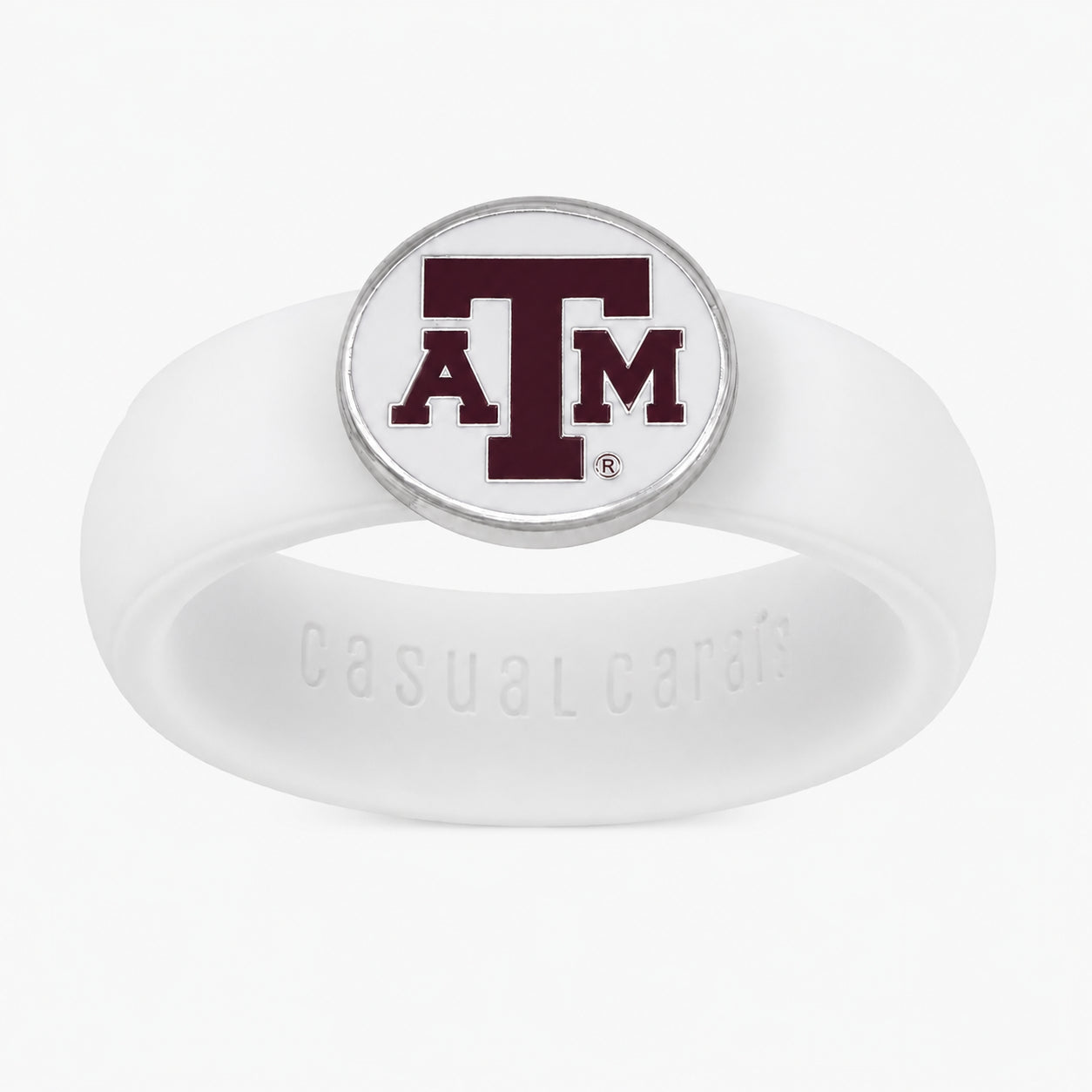

FAQ


